The Port of Barcelona's Energy Transition Plan will enable an 85% reduction in CO2 emissions by 2040
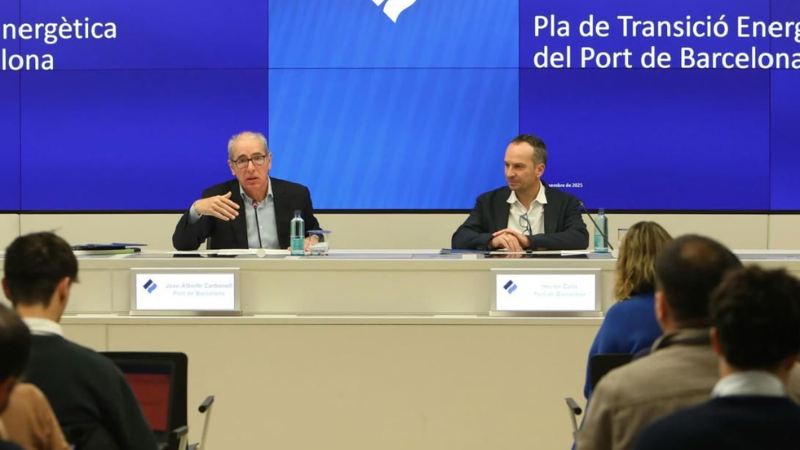
The Port of Barcelona has approved its Energy Transition Plan, a document derived from the Fourth Strategic Plan, which will set the port's energy policy until 2040, establishing the objective of reducing greenhouse gas emissions by 85% in 2040 compared to 2017, and sets the path to becoming an emissions-neutral port by 2050.
The Energy Transition Plan encompasses all the measures that the Port of Barcelona is undertaking to decarbonize port activity, guarantee the supply of sustainable energy, both environmentally and economically, and become a leading centre for energy activities. As its most immediate goal, the document sets out to halve emissions in 2030 compared to 2017 levels, which will mean reducing the emissions generated by one million tonnes in the period 2025 - 2030. This is equivalent to the annual emissions of 240,000 cars.
However, the Energy Transition Plan goes further than simply setting emission reduction targets to fight against climate change. With this Plan, the Port of Barcelona will no longer treat energy as a commodity but as a strategic factor key to bolstering the competitiveness of the port and the surrounding area in an increasingly demanding global market. This transformation will simultaneously consolidate the Port of Barcelona's leadership in both the maritime and port sectors and in the entire logistics chain, promoting the energy transition far beyond the port area.
Specific actions and objectives
In this connection, the document includes an Action Plan with over 150 actions, grouped into four main areas: decarbonising port activity; sustainability of energy consumption; resilience to guarantee energy supply and innovation to facilitate the emergence of new business models; and the adoption of emerging technologies.
This Action Plan includes specific measures to foster energy efficiency, setting the goal that in 2030, 50% of port activity will be electrified and 65% of container ship and cruise ship calls will be connected to OPS systems, allowing them to turn off their engines while in port, a figure that will increase to 90% by 2050.
The focus is also on local energy production, aiming to have 100 MWp of photovoltaic energy installed by 2030 and exploring formulas that allow for strategic management. However, production will not be limited to solar energy, as there are also plans to produce 100,000 tonnes of sustainable fuels per year - biomethane and synthetic fuels. These fuels are key to decarbonising maritime transport; being able to supply them allows us to be part of maritime green corridors and attract the most efficient and sustainable ships.
The Energy Transition Plan also impacts innovation, in both technologies and business models. Developing the hydrogen economy is one example, with the connection of the H2MED gas pipeline representing a great opportunity to make the Port of Barcelona a hub for this sustainable fuel. Nonetheless, the Plan also foresees other technologies such as CO2 capture systems and their subsequent use, through the circular economy, for producing synthetic fuels, among other elements.
A shared goal
The energy transition is a joint effort of Barcelona Port Community, therefore the Energy Transition Plan must allow all companies and organisations present in the port to align themselves around a common goal: to transform the port into a sustainable energies hub to lead the decarbonisation of the logistics chain. To enable this, planned investments in infrastructure total around €920 million in private funds and €780M in public funds.
Image source: portdebarcelona.cat


