Port of Antwerp Bruges Advances Its Vision for a Sustainable Port
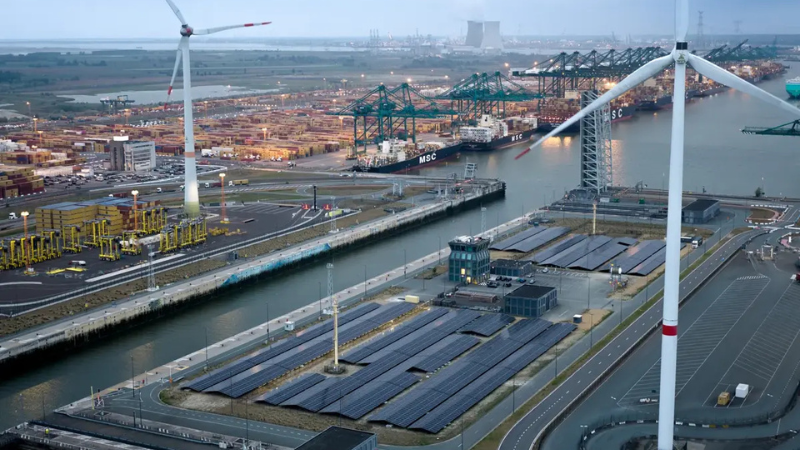
Port of Antwerp-Bruges is intensifying its efforts to become the world’s first port that successfully reconciles economic growth, climate goals, and social responsibility. Through large scale sustainability initiatives, green infrastructure investments, and digital innovation, the port aims to ensure that future generations continue to benefit from the prosperity and employment opportunities created by one of Europe’s most important logistics hubs.
The port’s long term strategy focuses on balancing people, climate, and economic activity while maintaining operational efficiency and global competitiveness. By 2030, the port plans to significantly increase the share of freight transported by rail, inland waterways, and pipelines in order to reduce road congestion and lower emissions. The organization has also committed to becoming climate neutral by 2050 as part of its broader transition toward a circular and low carbon economy.
Climate Neutrality and Green Energy Projects
Climate action forms one of the central pillars of the port’s sustainability strategy. Port of Antwerp Bruges is investing heavily in projects designed to reduce emissions, improve energy efficiency, and strengthen climate resilience across its infrastructure and operations.
The port is conducting climate risk analyses focused on challenges such as flood risks in Zeebrugge and water stress in Antwerp. At the same time, it is implementing mitigation strategies aligned with the Science Based Targets initiative methodology and the Greenhouse Gas Protocol for emissions accounting.
Several major sustainability projects are already underway, including Antwerp@C, green shipping corridors, shore power infrastructure, wind turbines, heat networks, and the deployment of electric trucks. The port is also working on greening operational services, climate neutral buildings, and transitioning its vehicle fleet toward low emission alternatives.
Protecting the Environment and Supporting Circularity
Beyond climate action, the port authority is placing strong emphasis on environmental protection and circular economy initiatives. Efforts are focused on improving nature conservation, water quality, and air quality across the port area while reducing pollution and industrial waste.
A major component of this strategy is the development of the NextGen District, an innovation hub dedicated to circular economy projects and sustainable industrial activities. Through these initiatives, Port of Antwerp Bruges aims to create an industrial ecosystem where waste streams and energy are reused more efficiently between companies operating within the port.
Focus on People and Social Responsibility
The port’s sustainability strategy also places significant attention on people and community impact. Internally, the organization focuses on employee health, safety, wellbeing, diversity, inclusion, and participation. Externally, it aims to improve working conditions throughout the supply chain while maintaining strong relationships with surrounding communities.
Through stakeholder engagement programmes, the port authority is working to ensure that economic growth within the port also creates value for local residents and businesses.
Governance, Security, and Digitalization
Strong governance and operational transparency are another important aspect of the port’s sustainability framework. The organization reports extensively on strategic planning, risk management, internal controls, anti corruption policies, and compliance procedures. A central Code of Conduct and independent internal audit functions support accountability across operations.
At the same time, the port continues investing in safety and digital technologies to improve operational resilience and cargo security. Projects include advanced radar and camera networks, cybersecurity initiatives, the Central Security Control Room in Zeebrugge, and compliance with the ISPS Code and Maritime Security Act.
Port accessibility is also being improved through infrastructure projects focused on rail development, dredging, cycling infrastructure, efficient customs processes, and the Extra Container Capacity Antwerp (ECA) project.
A Model for Sustainable Global Ports
Port of Antwerp Bruges demonstrates how major logistics hubs are evolving beyond traditional cargo handling operations toward becoming integrated sustainability and innovation platforms. By combining climate action, circular economy initiatives, digitalization, and social responsibility, the port aims to position itself as a global model for sustainable maritime logistics.
The strategy reflects a broader transformation taking place across the global port industry, where environmental performance, resilience, and sustainable infrastructure are becoming just as important as operational efficiency and cargo volumes.
Image source: portofantwerpbruges.com


