Global Supply Chains Enter a New Era: Report by Prologis

Prologis has released its 2026 Supply Chain Outlook Report, offering a detailed global assessment of how supply chains are evolving amid ongoing economic uncertainty, geopolitical risk and accelerating technological change. Based on a survey of 1,816 senior executives across the United States, United Kingdom, Germany, India, China and Mexico, the study provides insight into how companies are redesigning logistics networks, prioritising resilience and preparing for the next phase of supply-chain transformation.
Confidence Paired with Structural Change
Despite a volatile operating environment, 82% of surveyed executives reported confidence in their company’s performance in 2026. However, this confidence is not driven by a return to pre-crisis norms. Instead, companies are actively reshaping their supply chains to better manage disruption and uncertainty.
Key actions reported by respondents include the deployment of new technologies, increased risk monitoring and higher inventory buffers. These measures reflect a long-term shift from cost-driven optimisation toward resilience-focused planning.
Regionalisation Replaces Global Optimisation
One of the most significant findings in the report is the accelerating move toward regionalised supply chains. Nearly 58% of executives expect supply networks to become more regional by 2030, while 77% are already investing in more self-sufficient regional ecosystems.
Notably, energy reliability has overtaken labour costs as the primary driver of location decisions. As automation, electrification and AI increase power demand, access to stable and resilient energy infrastructure is now a central consideration in network design.
Artificial Intelligence Becomes Core Infrastructure
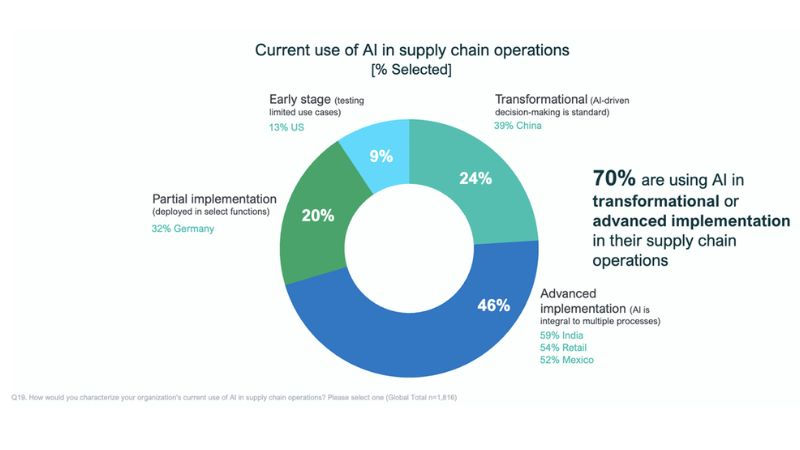
Artificial intelligence is no longer viewed as experimental. The report shows that 70% of companies have already implemented advanced or transformational AI solutions within their supply chains. AI is increasingly used for demand forecasting, inventory planning, risk detection and dynamic routing.
Executives anticipate that by 2030, AI will underpin most operational supply-chain decisions, enabling faster responses to volatility and improving end-to-end visibility.
Energy Reliability Emerges as a Critical Risk
Energy disruption is identified as one of the most urgent and underappreciated supply-chain risks. According to the report:
89% of companies experienced energy-related disruptions in the past year
83% believe energy reliability could become the next major supply-chain crisis
Many organisations expect power demand to increase by 10% to 50% over the next five years
This has given rise to what Prologis describes as the emerging “power chain” — the growing interdependence between logistics infrastructure and energy systems. Warehouses, distribution centres and manufacturing sites must now be designed with energy resilience in mind.
Diverging Strategic Approaches
The report identifies two dominant strategic profiles among supply-chain leaders:
Conservative operators, who prioritise incremental improvements and stability
Transformation-oriented leaders, who aggressively adopt new technologies and redesign networks
Companies in the latter group, particularly in growth markets and technology-intensive sectors, are positioning themselves to gain competitive advantage through speed, adaptability and resilience.
Implications for Logistics and Industrial Real Estate
For logistics providers, developers and infrastructure investors, the findings highlight several clear trends:
Continued demand for regional distribution hubs near consumption centres
Increasing importance of AI-enabled operations as a baseline capability
Growing premium on energy-ready and resilient logistics facilities
A decisive shift away from lowest-cost sourcing toward risk-balanced network design
Industrial real estate is no longer just about location and scale, but about reliability, power availability and technological readiness.
Image source: prologis.com


